Introduction
For months, there were back-and-forth warnings of Iran attacking Israel or Israel attacking Iran, but nothing happened until February 28, when Israel and the US struck Iran in one of the biggest escalations in Middle East history. This joint operation, dubbed “Operation Epic Fury” by the U.S. and “Operation Roaring Lion” by Israel, specifically targeted Iran’s leadership, nuclear infrastructure, and military capabilities. Within hours, Supreme Leader Ali Khamenei was killed, Iran’s air defenses were significantly degraded, and the broader region was plunged into open warfare. The immediate aftermath included Iranian missile and drone attacks targeting U.S. and Israeli assets across the Middle East, alongside a successful closure of the Strait of Hormuz, which severely disrupted global energy markets, highlighting the acute vulnerability of global energy supply chains to geopolitical disruptions, particularly within the Persian Gulf region, and the interconnectedness of regional stability with international economic security. The decision to launch strikes against Iran came after prolonged talks and ongoing unrest inside Iran: Indirect nuclear talks in Oman stalled in late February, and despite some Iranian offers, President Trump’s 10-day ultimatum from February 20 expired with no deal. Moreover, widespread anti-government protests rocked Iran early in 2026, and the regime’s brutal crackdown killed thousands, giving the U.S. a humanitarian reason to step in. This came on the heels of a rapid but intense 12-day war in June 2025 that already weakened Iran’s air defenses and cranked up tensions. Direct confrontations escalated in April, July, and October 2024, involving significant missile launches and airstrikes, culminating in Israel’s “Operation Rising Lion,” which specifically targeted Iranian nuclear facilities in June 2025. These earlier escalations set the stage for the February 2026 war, demonstrating a progressive transition from proxy engagements to direct, high-intensity military confrontations between Israel and Iran Iran quickly struck back at the US-Israel attacks on February 28, launching missiles and drones at Israel and US bases in the Gulf, including Bahrain, Qatar, the UAE, Kuwait, Saudi Arabia, Oman, and Jordan. They’ve since targeted airports, seaports, hotels, and oil refineries. Sadly, debris from downed missiles has caused some casualties. As mentioned above, Iran blocked the Strait of Hormuz, spiking oil prices worldwide and grounding nearly all flights in the Middle East.
Mojtaba Khamenei (the late leader’s son) has claimed the title of Supreme Leader amid a fragmented leadership, while the U.S. has stated it will only accept “unconditional surrender.”
Reactions of Abraham Accords signatories:
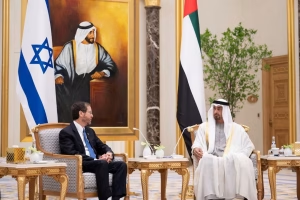
The Abraham Accords signatories (United Arab Emirates, Bahrain, Morocco, Sudan, and later Kazakhstan) reacted in different ways to the 2026 U.S.-Israel attack on Iran, largely shaped by two factors: Security threats from Iranian retaliation, especially in the Gulf, and their strategic ties with the United States and Israel since the 2020 normalization The first official statements from governments in the Gulf, with the exception of Oman, refrained from condemning the US-Israeli strikes
United Arab Emirates
The United Arab Emirates suffered some of the heaviest Iranian attacks in the region. Airports in both Dubai and Abu Dhabi, residential buildings, hotels, Dubai’s International Financial Center, Jebel Ali Port, and the U.S. consulate in Dubai have all been targeted. Although Iran claims it only targets U.S. bases, its strikes on the UAE show it considers the Emirates a strategic place to pressure Washington and disrupt global energy and financial systems. The UAE, a country known for openness and hospitality, where expatriates constitute about 90% of its roughly 11 million residents, responded in a balanced and cautious manner. Indeed, it did not openly support the U.S.-Israeli attack on Iran; hence, it called for calm and urged all sides to avoid escalation. At the same time, it condemned Iran’s missile and drone attacks on Gulf countries and strengthened its own security measures. The UAE also withdrew its diplomatic staff from Iran and made it clear that its land and airspace would not be used to launch attacks against Iran, thus emphasizing its commitment to protecting its sovereignty and maintaining regional stability.
Bahrain
Bahrain was directly affected by the escalation, as it became one of Iran’s targets during the retaliatory attacks. Bahrain (home to the U.S. Navy’s Fifth Fleet) stated that its air defense systems intercepted and destroyed 86 missiles and 148 drones that had targeted the kingdom since the beginning of the Iranian attacks. Authorities stressed that the use of ballistic missiles and drones against civilian areas and private property constitutes a blatant violation of international humanitarian law and the UN Charter. The Council of Representatives of Bahrain also condemned the Iranian missile attacks targeting the kingdom and other countries in the region, describing them as a flagrant violation of sovereignty and international law, and a serious threat to regional security and stability. The council emphasized that such hostile actions cannot be justified under any circumstances; it thus affirmed the legal right of Bahrain and other affected states to respond and take all necessary measures to protect their sovereignty, security, and stability, in accordance with international law and the United Nations Charter. It further called on the Inter-Parliamentary Union and parliamentary organizations worldwide to condemn the attacks and adopt firm positions to stop such hostile actions, thus reinforcing Bahrain’s stance in defense of regional security and international legal norms.
Morocco Regarding Morocco, it is not directly affected by the conflict, given its geographical distance from the Middle East. Moreover, Morocco does not have diplomatic relations with Iran; relations have therefore remained tense since Rabat cut ties in 2018, accusing Tehran of supporting and arming the Polisario Front. Morocco now strongly condemned what it described as an “abject” missile attack by Iran against several Arab Gulf countries, calling the strikes a “blatant violation of national sovereignty”. It also expressed full solidarity with its “brotherly Arab states” and voiced support for any legitimate measures taken to defend their security and protect their citizens, thus reaffirming its political alignment with its Gulf partners.
Sudan
The government of Sudan issued a statement strongly condemning what it described as blatant and illegal aggression by Iran against Qatar, Bahrain, Kuwait, and Jordan. The foreign ministry reaffirmed Sudan’s support for the sovereignty of these “sisterly states”. Interestingly, Sudan did not mention the UAE in its statement; this omission drew attention in diplomatic circles, particularly given the complex and tense relations between Sudan and the UAE in recent years. Thus, while Sudan clearly aligned itself with several Arab states affected by the strikes, its response also reflected the political sensitivities shaping its regional relationships.
Kazakhstan
Kazakhstan joined the Abraham Accords on November 7, 2025, becoming the first post-Soviet Muslim-majority country to take this step. During the current conflict, Kazakhstan has chosen to remain neutral so it can keep relations with Iran, Israel, the Gulf states, and the United States.
President Tokayev expressed solidarity with the countries affected by the attacks and thanked Saudi Arabia for helping evacuate Kazakh citizens. He also shared his regret that during Ramadan, the wider Muslim community has struggled to show mutual respect and unity.
What stood out was Kazakhstan’s silence toward Iran. Despite the close relationship between the two countries in recent years, President Tokayev did not offer any words of support to Tehran. Instead, in a phone call with UAE President Mohamed bin Zayed Al Nahyan, he said Iran’s strike on civilian sites in the UAE and other Gulf states “deserves strong condemnation,” according to a statement posted on Telegram. Tokayev also spoke with Qatar’s Emir, Tamim bin Hamad Al Thani, expressing full support and solidarity. In its official statement, Kazakhstan stressed: “the importance of reducing tensions, respecting international law, and working together to protect regional peace, security, and stability.”
Conclusion
In the end, the events of February 28 showed how quickly regional dynamics can change when tensions boil over. The U.S.-Israel strike on Iran, the latter’s fast and powerful response, and the reactions from the Abraham Accords countries all remind us that every nation is trying to balance its own security, alliances, and future. Some countries spoke firmly, others hedged, but all of them were affected in one way or another.
This regional conflict has shaken the economy, disrupted supply chains, and harmed the stability of the Gulf and surrounding areas. Iran is trying to create trouble across the region’s supply routes, and by limiting access to the Strait of Hormuz, it hopes to slow down the energy exports that many Gulf countries depend on. These pressures have added even more weight to a region already grappling with multifarious challenges. Still, even in difficult moments, there is room for hope. People across the Middle East long for calmer days, safer borders, and leaders who choose dialogue over escalation. And to the people of Iran, who have faced hardship, fear, and limits on their freedoms: many around the world sincerely hope that one day you will live with greater dignity, opportunity, and the ability to shape your own future peacefully and openly. Hard times never last indefinitely.
Sources:
https://www.bna.bh/en/news?cms=q8FmFJgiscL2fwIzON1%2BDga0%2F6j8Qo%2BDjri3OyBYaMM%3D#:~:text=Council%20of%20Representatives%20condemns%20Iranian%20missile%20attacks%2C%20affirms%20Bahrain’s%20right%20to%20respond
https://www.bbc.com/news/articles/cy8lzn2ejpjo
https://sudantribune.com/article/311224
https://thediplomat.com/2026/03/kazakhstans-pragmatic-foreign-policy-faces-uncertainty-amid-attacks-across-the-middle-east
https://www.aa.com.tr/en/world/kazakhstans-president-expresses-concern-over-situation-in-middle-east-with-uae-counterpart-and-qatari-emir/3846017
https://www.reuters.com/world/asia-pacific/kazakhstan-foreign-minister-discusses-middle-east-with-regional-ministers-2026-03-02