
The Dead Sea is one of the world’s most remarkable natural wonders, renowned not only for its extreme salinity and status as the lowest point on Earth, but also for its striking landscapes, cultural and historical significance, and longstanding appeal as a destination for tourism, wellness, scientific research, and religious pilgrimage. For centuries, its mineral-rich waters and therapeutic mud have attracted visitors from around the world, while its dramatic desert scenery has made it an iconic landmark shared by Israel, Jordan, and Palestine. Beyond its environmental significance, however, the Dead Sea represents something increasingly rare in the Middle East: a shared natural resource whose future depends not on unilateral action, but on cooperation between neighbouring states.
At a time when Israeli-Jordanian relations have reached one of their lowest points in decades, quite ironically the rehabilitation of the Dead Sea offers more than an environmental solution. It presents an opportunity for environmental diplomacy, a form of cooperation built not around political compromise, but around mutual interests. Unlike many bilateral issues that remain deeply contested, restoring the Dead Sea would produce tangible benefits for both countries by protecting tourism, safeguarding critical infrastructure, improving regional water management, preserving a globally significant ecosystem, and creating a practical framework through which trust and dialogue could gradually be rebuilt. While the decline of the Dead Sea is often discussed as an ecological crisis, it may equally represent one of the most promising opportunities for renewed Israeli-Jordanian cooperation.
Despite its immense natural, economic, and cultural value, the Dead Sea is shrinking at an alarming rate of approximately 1.15 to 1.2 meters per year, making it one of the fastest disappearing bodies of water on Earth. Once characterized by crystal clear blue waters extending far beyond the shoreline, large sections of the sea have receded dramatically, leaving vast expanses of eerily exposed lakebed. Roads in both Israel and Jordan have been rerouted as thousands of sinkholes have formed, swallowing agricultural land, threatening infrastructure, and forcing the closure of beaches and tourist attractions. Historically, the Dead Sea maintained a natural equilibrium between inflow from the Jordan River and evaporation. Over the past five to six decades, however, extensive upstream water diversion, large scale mineral extraction on both sides of the border, rising temperatures, and increasing human activity have significantly disrupted this balance. Although numerous initiatives have been proposed to reverse the decline, none has yet succeeded in producing a meaningful long term impact [5,9].

The Dead Sea’s deterioration is not confined to one country. The environmental, economic, and social consequences extend across both Israeli and Jordanian shorelines, making its restoration inherently transboundary. As beaches disappear, sinkholes expand, tourism declines, and infrastructure becomes increasingly vulnerable, neither country can fully protect its own interests without cooperation from the other. This reality distinguishes the Dead Sea from many other regional environmental challenges: its survival depends on collective action from both parent nations. Consequently, the question is no longer simply how to save the Dead Sea, but whether its restoration can also become a catalyst for strengthening Israeli-Jordanian relations through a shared commitment and responsibility to environmental resilience and sustainable development.
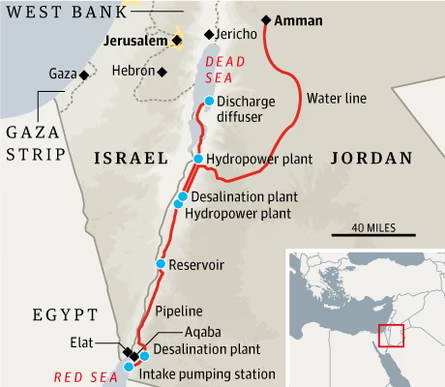
The idea of cooperation over the Dead Sea is not new. In 2013, Israel, Jordan, and the Palestinian Authority signed an agreement establishing the Red Sea Dead Sea Conveyance Project, a multi-phased initiative designed to desalinate water from the Red Sea while transferring concentrated brine into the Dead Sea to slow its decline. The project envisioned transporting approximately 80–100 million cubic meters of desalinated water through a pipeline originating in the Gulf of Aqaba, alongside roughly 100 million cubic meters of brine intended to replenish the Dead Sea. Although the agreement represented one of the region’s most ambitious examples of environmental cooperation, the project was ultimately abandoned by 2021 amid financial, political, and technical challenges, as well as diminishing support from the Israeli government [5].
The collapse of the Red Sea-Dead Sea Conveyance Project illustrates both the fragility and the potential of environmental diplomacy. Although the initiative ultimately failed, it demonstrated that Israel, Jordan, and the Palestinian Authority were capable of negotiating a shared response to a common environmental crisis despite profound political disagreements. Rather than signaling that cooperation is impossible, the project’s failure highlights the need for a more flexible, economically viable, and internationally supported approach to rehabilitation, one that places mutual environmental and economic interests at the center of bilateral engagement rather than treating the Dead Sea as a secondary component of broader political negotiations.
The Dead Sea as a Shared Strategic Asset
Unlike many environmental challenges in the Middle East, the decline of the Dead Sea is not confined by political borders. The shrinking shoreline affects Israel and Jordan simultaneously, creating environmental, economic, and infrastructural consequences that neither country can effectively address in isolation — mutual accountability and mutual responsibility. As a transboundary ecosystem, the Dead Sea represents one of the few regional challenges in which both countries share not only the same environmental problem, but also many of the same economic incentives for finding a solution. Consequently, its rehabilitation should be viewed not simply as an environmental objective, but as a strategic investment in regional resilience and long-term cooperation.
The environmental consequences of continued decline are becoming increasingly severe. As water levels recede by approximately 1.15 to 1.2 meters each year, thousands of sinkholes have emerged along both shorelines, damaging roads, agricultural land, utilities, and public infrastructure. Beaches that once attracted visitors have been abandoned as the shoreline continues to retreat, while fragile ecosystems surrounding the Dead Sea have experienced growing environmental stress. The Jordan River, historically the Dead Sea’s primary source of freshwater, now delivers only a fraction of its natural flow due to extensive upstream diversion for domestic, agricultural, and industrial use. Climate change has further intensified evaporation, accelerating a process that is already altering one of the world’s most unique geological landscapes. Without coordinated intervention, these environmental impacts will continue to intensify, increasing both ecological losses and the financial costs of future restoration.
The economic implications are equally significant. For decades, the Dead Sea has served as one of the region’s premier tourist destinations, attracting visitors seeking its distinctive landscape, mineral-rich waters, wellness tourism, and cultural heritage. Hotels, resorts, spas, nature reserves, restaurants, and countless local businesses on both the Israeli and Jordanian shores depend directly or indirectly on the continued health of the Dead Sea. As beaches disappear and infrastructure becomes increasingly vulnerable to sinkholes, tourism revenues face growing uncertainty. Protecting the Dead Sea is therefore not simply a matter of environmental conservation; it is essential to preserving thousands of jobs, supporting local economies, and safeguarding billions of dollars in existing and future investment.
Beyond tourism, the Dead Sea continues to support significant industrial activity. Mineral extraction industries on both sides of the border contribute substantially to national economies through the production of potash, bromine, magnesium, and other minerals used worldwide in agriculture, pharmaceuticals, and manufacturing. While these industries have benefited economically from the Dead Sea’s natural resources, they have also contributed to accelerating its decline through extensive evaporation processes. This creates a shared responsibility for both governments and industry to balance continued economic activity with long-term environmental sustainability. Failure to do so risks undermining the very resource upon which these industries depend.
The Dead Sea’s importance also extends beyond economics. As one of the world’s most distinctive natural landscapes, it represents an internationally significant environmental and cultural heritage site whose preservation carries scientific, historical, and symbolic value. Researchers from around the world continue to study its unique hydrology, geology, microbiology, and changing climate conditions, while millions recognize it as one of the Middle East’s defining natural landmarks. Allowing such a globally significant ecosystem to disappear would represent not only a regional environmental failure but also the loss of an irreplaceable natural resource with international importance.
Taken together, these environmental, economic, and cultural considerations demonstrate why the rehabilitation of the Dead Sea should not be viewed as an Israeli project or a Jordanian project, but as a shared regional priority. Unlike many issues dividing the two countries, restoring the Dead Sea produces mutual gains with few inherent trade-offs. Every meter of stabilized water level protects infrastructure on both sides of the border, supports tourism in both countries, preserves internationally significant ecosystems, and strengthens long-term water resilience. In this respect, the Dead Sea offers something increasingly rare in regional politics: a challenge in which cooperation is not merely desirable, but objectively more beneficial than unilateral action.
Environmental Diplomacy in a Time of Political Tension
Although the rehabilitation of the Dead Sea presents compelling mutual benefits, implementing a joint restoration initiative is considerably more difficult in today’s geopolitical climate. Relations between Israel and Jordan have deteriorated significantly in recent years, placing considerable strain on one of the Middle East’s longest standing peace agreements. Nevertheless, despite recurring diplomatic crises, cooperation over shared natural resources has historically remained one of the most resilient pillars of the bilateral relationship, demonstrating that practical environmental interests can often endure even when political relations falter.
The foundation for this cooperation was established through the 1994 Israel-Jordan Peace Treaty, which formally ended decades of conflict and recognized water as a shared strategic resource. Among its provisions, Israel committed to supplying Jordan with approximately 50 million cubic meters (MCM) of water annually from the Sea of Galilee while both countries agreed to pursue long-term cooperation on regional water management. For decades, these arrangements demonstrated that environmental necessity could overcome political disagreement, providing a stable mechanism for collaboration despite periods of regional instability.

Building on this framework, Israel, Jordan, and the Palestinian Authority signed the Red Sea-Dead Sea Conveyance Project agreement in 2013. The project envisioned transporting desalinated water from the Gulf of Aqaba while returning concentrated brine to the Dead Sea, simultaneously addressing Jordan’s growing water shortages and slowing the Dead Sea’s decline. Although the project was ultimately abandoned by 2021 due to financial, political, and technical challenges, it nevertheless illustrated an important reality: even amid profound political disagreements, the parties were able to negotiate a shared response to a common environmental challenge but thoughts and intentions alone aren’t enough here [5].
Water cooperation has, however, become increasingly complicated. In 2021, Israel and Jordan reached an agreement for Israel to supply an additional 50 MCM of water beyond the amount guaranteed under the peace treaty. As the agreement approached renewal in 2024, disagreements over new political conditions, coupled with the rapidly deteriorating regional climate, prevented its extension. Israeli media attributed the collapse in part to growing tensions surrounding the war in Gaza and Jordan’s increasingly critical stance toward Israeli government policies, resulting in a return to the original allocation established under the 1994 treaty [6].
The conflict in Gaza, together with Israel’s military operations in the West Bank, has further strained bilateral relations. Following October 7, 2023, Jordan withdrew its ambassador from Israel in response to what it described as an “unprecedented humanitarian crisis in Gaza,” while domestic opposition to visible cooperation with Israel intensified considerably, particularly given Jordan’s large population of Palestinian origin [7]. At the same time, the escalating confrontation between Israel and Iran has heightened Jordan’s security concerns, with Jordanian forces intercepting drones and missiles crossing its airspace during Iranian attacks on Israel, as well as projectiles reportedly directed toward Jordanian territory [9]. These developments have understandably narrowed the political space for launching new high-profile bilateral initiatives.
Yet it is precisely during periods of heightened political tension that environmental diplomacy becomes most valuable. Unlike territorial disputes or broader geopolitical negotiations, the rehabilitation of the Dead Sea is not a zero-sum issue. Both countries face the same environmental degradation, the same economic losses from declining tourism, the same threats to infrastructure from expanding sinkholes, and the same long-term challenges posed by climate change and water scarcity. Every delay increases costs for both governments, while every successful restoration measure generates mutual benefits. In this respect, cooperation over the Dead Sea should not be viewed as a political concession but as a shared investment in regional resilience.
The continued decline of the Dead Sea therefore presents a paradox. Political tensions have made cooperation more difficult, yet the worsening environmental crisis has made cooperation more necessary than ever. Rather than allowing regional instability to halt joint action, the Dead Sea offers one of the few remaining opportunities through which Israel and Jordan can pursue meaningful collaboration based on practical necessity rather than political ideology. As one of the world’s most water-scarce countries, Jordan has a critical interest in sustainable water solutions, while Israel possesses internationally recognized expertise in desalination, wastewater reuse, and integrated water management. Together, these complementary strengths create a foundation upon which environmental cooperation can contribute not only to ecological restoration, but also to rebuilding confidence, strengthening institutional relationships, and demonstrating that shared natural resources can continue to unite neighboring states even during periods of profound political disagreement.
From Policy to Action: Why Rehabilitation Has Stalled
Despite broad recognition of the Dead Sea’s environmental and economic importance, meaningful rehabilitation efforts have consistently fallen short of government commitments. The challenge is no longer a lack of awareness, but rather a lack of coordinated implementation. Numerous strategies have been proposed over the past two decades, substantial budgets have been allocated, and repeated warnings have been issued by scientists, policymakers, and government agencies. Yet the Dead Sea continues to decline unchecked, illustrating the widening gap between policy ambitions and practical action.
This implementation gap was highlighted in Israel’s 2025 State Comptroller’s report, which found that progress toward rehabilitating and developing the northern Dead Sea had fallen well behind government commitments. Of the twelve tourism development projects identified for the northern basin, only one had been completed despite a dedicated government development plan and an allocated budget of approximately NIS 98 million (US$26 million). The report concluded that implementation across multiple ministries and agencies had been fragmented, resulting in significant delays to projects intended to strengthen tourism, improve infrastructure, and protect surrounding communities [9].
The report also emphasized the growing environmental and public safety consequences of continued inaction. As the Dead Sea continues to decline by approximately 1.15–1.2 meters annually, expanding sinkholes have damaged roads, public infrastructure, and nearby communities, while threatening major tourist destinations such as Ein Gedi. Although discussions regarding an insurance mechanism for sinkhole-related property damage have continued for more than two decades, no comprehensive system has been established by 2025. Likewise, several planned mitigation projects designed to protect Route 90 from sinkhole-related hazards remained incomplete despite years of planning [9].
More broadly, the Comptroller concluded that Israel remains insufficiently prepared to address the long-term impacts of climate change. Most government ministries had yet to develop practical climate adaptation plans supported by dedicated budgets, implementation timelines, or measurable performance indicators. Institutional capacity within the Ministry of Environmental Protection also remained limited, constraining its ability to coordinate national climate policy and advance large-scale environmental initiatives. Progress toward national greenhouse gas reduction targets similarly lagged behind government commitments, reinforcing concerns that climate adaptation has struggled to compete with more immediate political and security priorities [9].
Importantly, the report did not suggest that the Dead Sea lacks national importance. On the contrary, the Comptroller described it as an irreplaceable environmental, economic, and cultural asset whose continued deterioration poses increasing risks to Israel’s infrastructure, tourism industry, and climate resilience. The report’s central criticism was directed not at the government’s vision, but at its inability to translate that vision into coordinated action. This distinction is significant. It suggests that the principal obstacle to rehabilitation is not uncertainty over whether the Dead Sea should be restored, but rather how such restoration should be implemented, financed, and managed across multiple institutions and stakeholders.
These findings also reinforce the argument for expanding rehabilitation beyond a purely national initiative. Because the environmental, economic, and diplomatic benefits extend across international borders, restoration efforts would likely be strengthened through broader regional and international partnerships. Collaborative funding mechanisms, joint scientific research, and multilateral governance structures could help overcome institutional fragmentation while distributing both the costs and benefits of long-term rehabilitation. In this sense, the Dead Sea’s decline represents not only a challenge for Israel, but an opportunity for Israel, Jordan, and the international community to demonstrate how shared environmental problems can be addressed through coordinated regional action.
What Could Be Done?
While the need to rehabilitate the Dead Sea is widely acknowledged, experts continue to debate the most effective path forward. Some scientists argue that large-scale diversion projects, such as transferring water from the Red Sea, could alter the Dead Sea’s unique chemistry or even accelerate sinkhole formation. Others contend that the volume of water required to meaningfully stabilize the sea is unlikely to be achieved through currently proposed projects alone. Alternative proposals, including a conveyance from the Mediterranean Sea, have also been suggested, but these would require extensive regional coordination, significant financial investment, and political agreement among Israel, Jordan, and the Palestinian Authority. Given the ongoing instability in Gaza and broader regional instability, implementing such large-scale infrastructure projects remains a considerable challenge [2].
Scientific uncertainty, however, should not be interpreted as justification for continued inaction. Environmental restoration projects are rarely implemented with complete certainty, particularly when addressing complex ecosystems affected by decades of human intervention. Rather than delaying action until a single perfect solution emerges, Israel and Jordan could pursue a phased rehabilitation strategy that combines additional scientific research, pilot projects, enhanced monitoring, and adaptive management. Such an approach would allow both countries to evaluate different restoration methods while gradually slowing the Dead Sea’s decline.
A practical way to advance this process would be through an internationally supported partnership. Rather than relying exclusively on bilateral political agreements, Israel and Jordan could jointly seek funding through programs such as Horizon Europe, PRIMA, the World Bank, and other international climate and environmental initiatives. These organizations increasingly prioritize projects that combine climate adaptation, sustainable development, and regional cooperation. A consortium involving Israeli and Jordanian government ministries, universities, research institutes, regional authorities, non-governmental organizations, and international technical partners would not only strengthen the scientific foundation of a rehabilitation project but also increase its attractiveness to international funders.
Such a partnership would extend beyond engineering solutions. Joint environmental monitoring, scientific research, tourism planning, water management, and climate adaptation initiatives would create sustained professional collaboration between experts and institutions on both sides of the border. These technical relationships have the potential to build confidence gradually, strengthen communication, and establish practical channels of cooperation that remain resilient even during periods of political tension. Environmental diplomacy is often most successful when it begins with shared technical objectives before expanding into broader political dialogue.
Conclusion
The future of the Dead Sea is often framed as an environmental challenge, yet its significance extends far beyond the changing shorelines. As a shared natural resource, it presents Israel and Jordan with a rare opportunity to pursue cooperation based on mutual benefit rather than political compromise. Restoring the Dead Sea would protect one of the world’s most extraordinary natural landmarks while preserving tourism, safeguarding infrastructure, strengthening regional water security, and supporting local economies that depend upon its continued existence.
Perhaps more importantly, the Dead Sea offers a practical platform for environmental diplomacy at a time when traditional diplomatic channels face unprecedented strain. Throughout the history of Israeli-Jordanian relations, cooperation over water has frequently endured despite broader political disagreements because both countries recognize that natural resources cannot be managed according to political boundaries alone. The rehabilitation of the Dead Sea builds upon this same principle. By combining Jordan’s urgent need for sustainable water solutions with Israel’s internationally recognized expertise in desalination, water reuse, and environmental management, both countries possess complementary strengths that could form the basis of a renewed partnership.
Whether the Dead Sea can ultimately bring Israeli-Jordanian relations back to life will depend on political will, sustained investment, and international support. Yet allowing one of the world’s most unique ecosystems to disappear would represent a shared failure with consequences that neither country can afford, nor should allow. In contrast, choosing to restore it offers something far more valuable than environmental conservation alone: an opportunity to demonstrate that even in one of the world’s most politically complex regions, shared environmental challenges can foster trust, strengthen regional resilience, and lay the foundation for a more cooperative future with benefits spanning far beyond the Dead Sea’s sparkling waters.
Resources:
[1] Anadolu Agency. Israel Halts Renewal of Jordan Water Deal: Report. 2025, http://aa.com.tr/en/middle-east/israel-halts-renewal-of-jordan-water-deal-report/3987955. Accessed 25 July 2026.
[2] Arab News. Jordan and Israel Tensions and Water Cooperation. 2022, https://www.arabnews.com/node/2211306/middle-east. Accessed 25 July 2026.
[3] Berman, Lazar. Parched Jordan Fuming at Israeli Refusal to Renew Expired Water Deal – Report. The Times of Israel, https://www.timesofisrael.com/parched-jordan-fuming-at-israeli-refusal-to-renew-expired-water-deal-report/. Accessed 25 July 2026.
[4] Climate Diplomacy. Jordan and Israel: Tensions and Water Cooperation in the Middle East. Adelphi, https://climate-diplomacy.org/case-studies/jordan-and-israel-tensions-and-water-cooperation-middle-east. Accessed 25 July 2026.
[5] DeadSea.com. Jordan Dead Sea Shrinking. https://deadsea.com/jordan/attraction/jordan-dead-sea-shrinking/. Accessed 25 July 2026.
[6] Fanack Water. The End of the Israel–Jordan Water Agreement? https://water.fanack.com/end-israel-jordan-water-agreement/. Accessed 25 July 2026.
[7] Institute for National Security Studies (INSS). Jordan–Israel Water Relations. https://www.inss.org.il/publication/jordan-israel-water/. Accessed 25 July 2026.
[8] University of Leeds. Dead Sea Presentation. Arava Institute SharePoint presentation, 2025.
[9] Ynet News. State Comptroller: Israel Unprepared for Dead Sea Decline and Climate Change. https://www.ynetnews.com/environment/article/syklzsw7fx. Accessed 25 July 2026.


